Machining productivity depends on more than cutting speed. Repeated setups, workpiece repositioning, loading, and unloading add time to machining cycles and affect machine utilization.
A Horizontal Machining Center (HMC) can help address these challenges when components require machining on multiple faces. With suitable work holding and process planning, manufacturers can consolidate operations and reduce certain non-cutting activities.
How Horizontal Machining Centers Reduce Setup Time
An HMC uses a horizontal spindle for milling, drilling, tapping, and boring. Depending on component geometry and fixture design, multiple faces can be machined with fewer manual repositioning steps.
This is useful for gearbox housings, hydraulic blocks, valve bodies, and industrial castings. Reducing repeated setups can limit handling and alignment time. Actual benefits depend on tool access, fixture design, indexing requirements, and machining sequence.
Productivity Beyond Cutting Time
The total machining cycle includes loading, unloading, alignment, setup changes, and movement between operations. Managing these activities can help manufacturers make better use of available machine time.
- Reduce repeated handling: Machining multiple faces in one setup can reduce workpiece repositioning.
- Prepare the next job: Arranging tools, fixtures, and raw materials in advance can minimize delays between jobs.
- Limit movement between operations: Completing suitable operations on one machine can reduce transfers between workstations.
- Improve machine utilization: Reviewing setup and waiting time helps identify avoidable delays and improve workflow.
An HMC does not automatically eliminate non-cutting time. The outcome depends on the component, machining process, and production planning.
How Work holding and Pallet Strategy Support Productivity
Suitable fixtures secure components while providing access to the required machining faces. Proper indexing can reduce manual repositioning, provided tool clearance and fixture interference are considered.
Where a pallet-changing system is available, operators may prepare one workpiece while another is being machined. This can reduce loading-related interruptions when the production volume and workflow justify it.
Preparing tools, fixtures, and workpieces in advance can further reduce delays between machining cycles.
HMC vs VMC: Which Suits Your Workflow?
A Horizontal Machining Center may suit components requiring multi-face machining and frequent repositioning. A Vertical Machining Center (VMC) may be appropriate when components are accessible from above and require fewer setups.
The choice depends on component geometry, machining operations, work holding, production volume, and overall process cost.
What Should Manufacturers Evaluate Before Choosing an HMC?
Before selecting an HMC, consider:
- Component size and weight: Working envelope and table or pallet capacity.
- Machining requirements: Required faces, features, and operations.
- Spindle capability: Speed, torque, and power.
- Workholding and indexing: Component support and tool access.
- Pallet and automation needs: Suitability for the production workflow.
- Non-cutting time: Setup, handling, and waiting activities.
Horizontal Machining Solutions from STM CNC
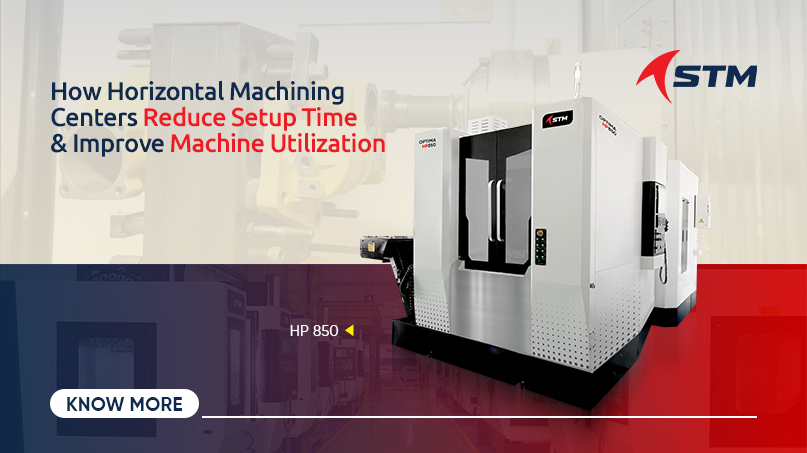
Built on world-class engineering for Indian manufacturers, the STM CNC HMC Optima Series offers horizontal machining solutions for different component sizes and machining requirements. Evaluating component geometry, required operations, workholding, and production workflow helps manufacturers identify a suitable solution.
Connect with STM CNC to discuss your component requirements and explore suitable horizontal machining solutions.