The difference isn't always the number of machines on the shop floor. It can also come down to how effectively each machine handles its machining requirements.
Cycle time, machining accuracy, workpiece dimensions, tooling and machine capability all influence overall productivity. Choosing a suitable VMC machine can therefore make a difference to how manufacturers manage their shop-floor operations.
A Vertical Machining Center (VMC) brings multiple machining operations into a single machine configuration. Its structure, spindle performance, working envelope and axis movement all contribute to its machining capabilities.
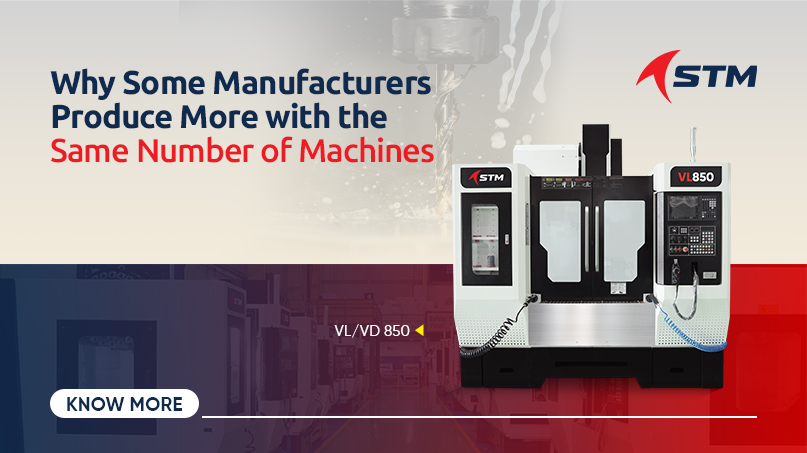
The STM CNC VL850/VD850 are designed for manufacturers who require a spacious working envelope, a stable machine structure and spindle configurations suited to different machining applications.
Let's look at the features manufacturers should evaluate when selecting a VMC for their shop floor.
1. A Working Envelope That Accommodates Your Components
When selecting a Vertical Machining Center, the working envelope is one of the first parameters to evaluate.
The STM CNC VL850/VD850 offer 850 × 510 × 510 mm X, Y and Z-axis travel, making them suitable for machining a range of medium-sized components across automotive, precision engineering, mould and die, and general engineering applications.
Their 1000 × 500 mm worktable provides space for accommodating components and their fixture arrangements. With a maximum table load capacity of 800 kg, the machine supports workpieces within its specified loading limit.
For manufacturers evaluating a 3-axis VMC machine, table dimensions, axis travel and load capacity are important considerations. These parameters help determine whether the machine can accommodate the component, fixture and machining operations.
2. Choose the Spindle Configuration for Your Machining Requirements
Spindle configuration plays an important role in determining the suitability of a CNC VMC machine for different cutting operations.
The STM CNC VL850/VD850 are available with two spindle transmission configurations:
VL850 - Belt-Drive Spindle
- BBT40 spindle
- 8,000 RPM standard
- 10,000 / 12,000 RPM optional
VD850 - Direct-Drive Spindle
- BBT40 spindle
- 8,000 RPM standard
- 10,000 / 12,000 / 15,000 RPM optional
This gives manufacturers the flexibility to evaluate a spindle configuration based on their tooling, workpiece material and machining requirements.
The appropriate spindle speed, combined with suitable cutting tools and machining parameters, influences material removal, cycle time, surface finish and tool performance. The choice should therefore be based on the actual application rather than RPM alone.
3. A Stable Structure for Demanding Machining Applications
During machining, cutting forces act on the machine structure. The ability to manage these forces is important, particularly when working with demanding cutting parameters.
The STM CNC VL850/VD850 feature a broad base and heavy column. This structural design helps improve vibration damping and machine balance during heavy machining.
The broad table is supported by precision LM Roller Guideways, designed to provide high load-carrying capacity and support-controlled axis movement.
Together, these construction features provide a stable foundation for machining applications that require material removal and consistent machine performance.
For manufacturers evaluating a VMC milling machine, machine structure and guideway configuration deserve as much attention as spindle speed and working envelope.
4. How the Right VMC Configuration Supports Shop-Floor Productivity
Manufacturers looking to improve machining productivity should evaluate the complete capability of their CNC machines rather than focusing only on machine count.
A suitable VMC configuration can support different machining requirements through:
- Working envelope: Accommodates components within the machine's travel and table dimensions.
- Table load capacity: Helps determine whether the component and fixture arrangement are within the machine's specified loading limit.
- Spindle configuration: Offers options to match different cutting conditions and tooling requirements.
- Machine construction: The broad base and heavy column support vibration damping and machine balance.
- Guideway system: LM Roller Guideways support controlled axis movement and table load carrying capacity.
Manufacturers should also consider component dimensions, machining time, work holding, tooling and expected production volumes.
The objective is to select a machine that matches the actual application and supports effective utilization of available shop-floor resources.
5. STM CNC VL/ VD850: Key Technical Specifications
The STM CNC VL850/VD850 share the same published table dimensions, axis travel and core machine specifications. Their primary distinction is the spindle transmission configuration: belt drive for the VL850 and direct drive for the VD850.
|
Parameter |
VL850 |
VD850 |
|
Table Size |
1000 × 500 mm |
1000 × 500 mm |
|
X-Axis Travel |
850 mm |
850 mm |
|
Y-Axis Travel |
510 mm |
510 mm |
|
Z-Axis Travel |
510 mm |
510 mm |
|
Maximum Table Load |
800 kg |
800 kg |
|
Spindle Taper |
BBT40 |
BBT40 |
|
Spindle Transmission |
Belt Drive |
Direct Drive |
|
Standard Spindle Speed |
8,000 RPM |
8,000 RPM |
|
Optional Spindle Speeds |
10,000 / 12,000 RPM |
10,000 / 12,000 / 15,000 RPM |
Both models are designed for machining applications ranging from production machining to die and mould work. Manufacturers can evaluate the belt-drive and direct-drive options based on their application and required spindle configuration.
6. Find the Right VMC Machine for Your Manufacturing Requirements
Choosing the right CNC machine starts with understanding what your machining applications demand.
Whether you are machining automotive components, precision engineering parts, mould and die components or general engineering workpieces, selecting a suitable Vertical Machining Center is an important step.
Explore the STM CNC VMC VL850/VD850 to compare their spindle configurations, working envelope and machine construction.
Connect with the STM CNC team to discuss your component requirements and identify the right VMC configuration for your applications.