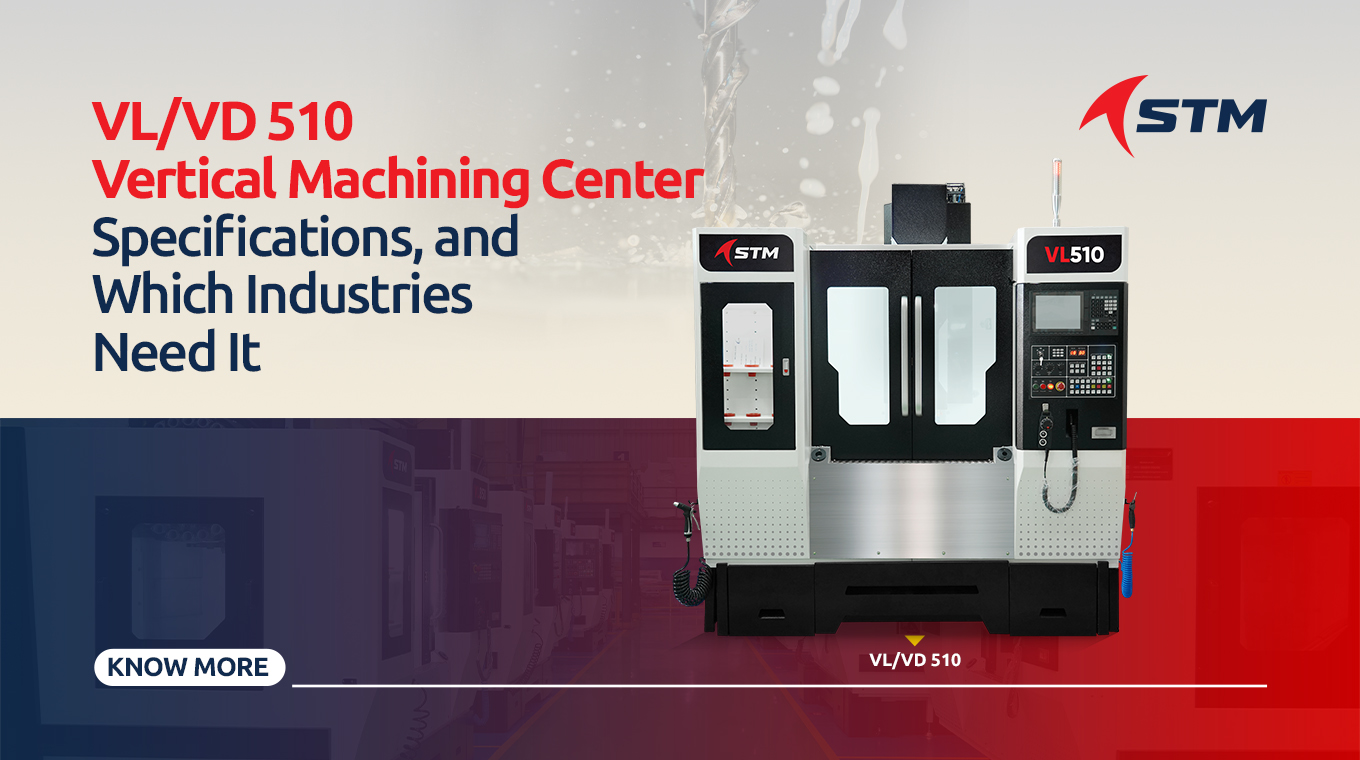
When components are small or compact, machining requirements can still involve multiple operations, different tooling, and varying spindle-speed requirements. The right VMC machine needs to provide the required machining workspace, spindle capability, tool holding, and flexibility without unnecessary machine capacity.
This is where an STM VL/VD 510 Vertical Machining Center can be a practical solution for suitably sized component machining.
STM VL/VD 510 Specifications at a Glance
- Table Size: 650 × 410 mm
- X × Y × Z Travel: 550 × 410 × 480 mm
- Spindle Interface: BBT40
- Belt Drive: 8000 RPM standard; 10,000 / 12,000 RPM optional
- Direct Drive: 8000 RPM standard; 10,000 / 12,000 / 15,000 RPM optional
The table size and axis travels provide the working envelope for suitably sized components. Actual component size, workholding, tool access, and machining requirements should be evaluated before selecting the machine.
What Makes the STM VL/VD 510 Suitable?
The STM VL/VD 510 combines a compact machining envelope with a BBT40 spindle interface and multiple spindle-speed configurations.
The available spindle options allow manufacturers to select a configuration according to the material, tooling, cutting conditions, and machining requirements.
The direct-drive option up to 15,000 RPM can be considered for applications requiring higher spindle speeds and suitable tooling.
Applications of STM VL/VD 510
The STM VL/VD 510 can be considered for drilling, milling, tapping, and other machining operations on suitably sized components.
Automotive
Brackets, housings, and other smaller components.
Tool & Die
Smaller moulds, fixtures, tooling, and related components.
Electronics & Enclosures
Aluminium enclosures and appropriately sized precision components.
General Engineering
Batch and job-based machining of components matching the machine's working envelope.
Suitable Materials
Material suitability depends on machine configuration, tooling, workholding, cutting parameters, and component requirements.
Applications can include:
- Aluminium and other non-ferrous materials
- Mild steel
- Alloy steel
- Cast iron
Material-specific cutting conditions should be evaluated for each application.
Key Benefits for Manufacturers
Compact Footprint:
Useful where floor-space utilization is important.
BBT40 Spindle:
Provides a rigid tool-holding interface for a range of machining applications.
Spindle Flexibility:
Belt-drive and direct-drive options support different machining requirements.
Multiple Operations:
Drilling, tapping, milling, and other operations can be performed depending on the component and tooling.
How Do You Know If It Fits Your Application?
Before selecting the VL/VD 510, evaluate:
- Component dimensions
- Required X, Y, and Z travel
- Material
- Machining operations
- Work holding and tooling
- Required spindle speed
- Production volume
- Target cycle time
The right VMC machine should be selected based on the complete machining requirement, not a single specification.
FAQs
What type of components suit the STM VL/VD 510?
Small and suitably sized components whose dimensions, tooling, work holding, and machining operations fall within the machine's capabilities.
What spindle options are available in STM VL/VD 510?
BBT40 belt-drive and direct-drive configurations are available, from 8000 RPM standard to 15,000 RPM optional, depending on configuration.
How do I choose the right configuration?
Consider the material, tooling, machining operations, spindle speed, production volume, and cycle-time requirements.
Looking for a Compact VMC?
Looking for a compact, high-precision CNC Vertical Machining Center for your production requirements? Contact S&T Machinery (STM) today to discuss your application and discover how the VL/VD 510 can improve productivity and machining performance.
Backed by over 30 years of expertise, S&T Machinery (STM) stands as one of India’s leading CNC machine manufacturers, delivering advanced solutions to customers worldwide. With a strong focus on innovation and customer needs, STM CNC continues to solve real manufacturing challenges while bringing global engineering standards to Indian manufacturers.